12 min read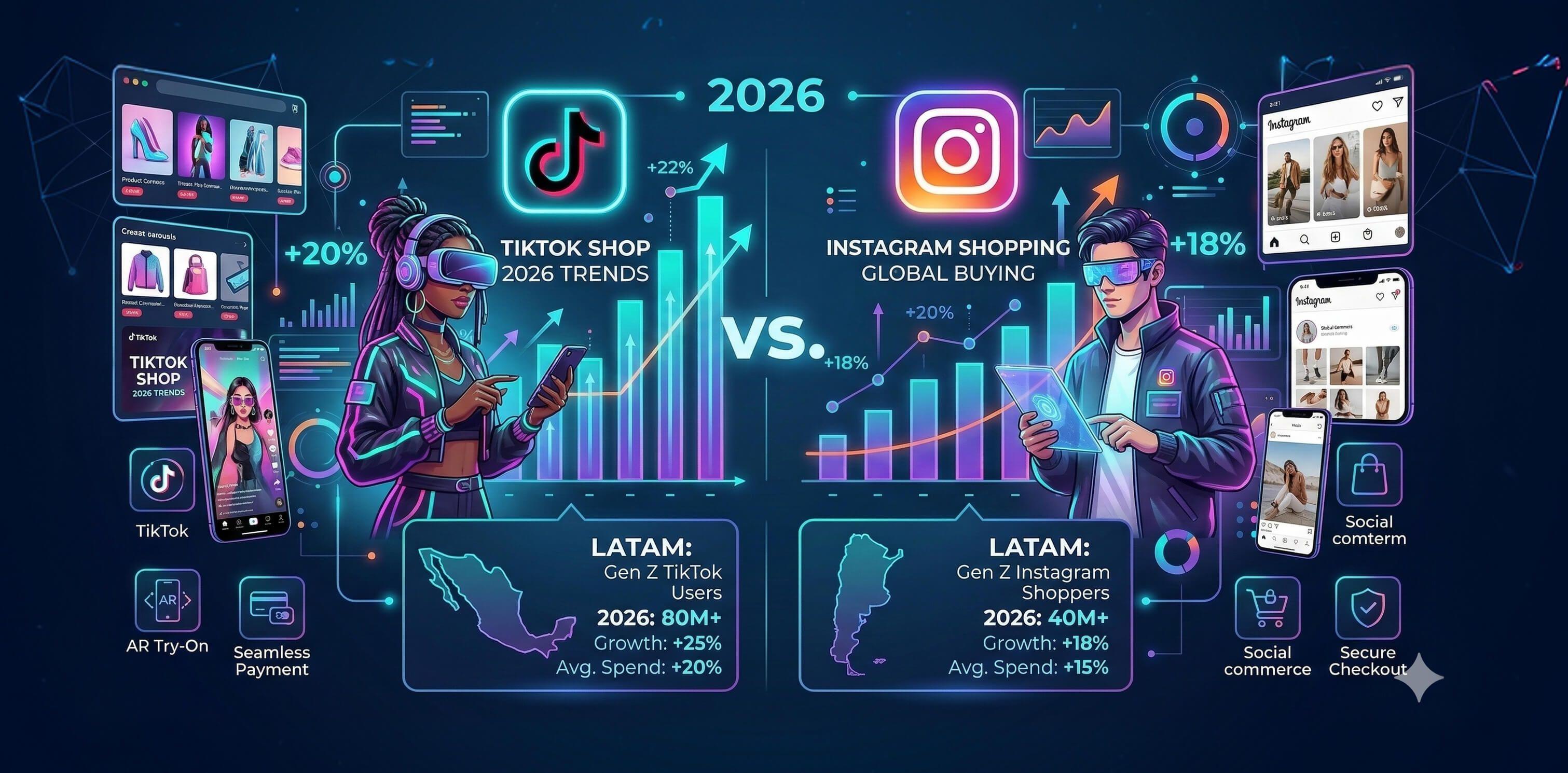
If you're a brand trying to reach Gen Z in 2026, you're probably feeling like you're stuck in a digital version of The Matrix—except instead of choosing between the red pill and the blue pill, you're choosing between TikTok's algorithmic rabbit hole and Instagram's aesthetic wonderland. And let me tell you, the stakes have never been higher.
The global social commerce market is hurtling toward a staggering $992.38 billion this year, with a compound annual growth rate of 13.7%. But here's the real kicker: social commerce isn't just part of the retail landscape anymore—it's becoming the main event. By 2030, it's projected to hit $1.616 trillion, and Generation Z is holding the remote control.
So where exactly is Gen Z spending their money? Let's dive into the great social commerce schism of 2026.
The Numbers Don't Lie: TikTok's Volume vs. Instagram's Value
First, let's get the scoreboard straight. In the US social commerce arena, Meta's combined empire (Facebook + Instagram) still commands a dominant ~75% market share, while TikTok Shop has carved out an impressive ~20-24.1% slice of the pie.
But raw market share doesn't tell the whole story. When we zoom in on Gen Z specifically, TikTok emerges as the undisputed champion of transactional frequency. A whopping 40% of Gen Z shoppers use TikTok as their primary shopping destination, compared to just 20% for Instagram.
However—and this is a big however—Instagram shoppers spend nearly three times more per transaction. While TikTok's median Average Order Value (AOV) hovers between $35 and $67, Instagram shoppers are dropping $95 to $100 per purchase on average.
| Platform Performance Snapshot | TikTok Shop | Instagram Shopping |
|---|---|---|
| Gen Z Usage Rate | 40% | 20% |
| Average Conversion Rate | 2.0% - 8.0% | 1.5% - 3.5% |
| Top-Tier Conversion (Beauty) | 10.0% - 12.0% | 4.5% - 5.2% |
| Median Average Order Value | $35 - $67 | $95 - $100 |
| Monthly Active Users (2026) | 1.9 - 2.0 Billion | 3.0 Billion |
| Avg. Time Spent per Day | 95 Minutes | 30 - 60 Minutes |
Source: Pulse Advertising, CreatorFlow
Think of it this way: TikTok is the digital equivalent of a bustling flea market where you discover amazing $20 finds you never knew you needed. Instagram is the curated boutique where you invest in pieces that become part of your identity. Both are essential—but they serve fundamentally different purposes in the Gen Z wallet.
1: Algorithm Fatigue vs. Aesthetic Echo Chambers
Here's where things get fascinating. TikTok's "For You Page" (FYP) algorithm is arguably the most powerful discovery engine ever built. It democratizes reach, meaning a brand with zero followers can go viral overnight if their content resonates. This has created what I call the "compressed commerce loop"—where discovery, validation, and purchase happen in a single, seamless scroll.
But there's a dark side to this algorithmic magic. When every Gen Z user is fed a hyper-personalized stream of content optimized for maximum engagement, we start seeing what I call "algorithmic aesthetic convergence." Suddenly, everyone's For You Page looks eerily similar—same viral products, same trending aesthetics, same impulse buys. It's like we've traded the joy of serendipitous discovery for the efficiency of predictive homogenization.
Instagram, by contrast, operates on a more fragmented discovery model. Yes, Reels compete with TikTok's short-form dominance, but Instagram's core strength remains its follower-based ecosystem. Discovery happens across Reels, Explore, and the dedicated Shop tab—but it's anchored in social connections and consistent brand aesthetics.
This architectural difference creates what I call "aesthetic islands"—pockets of brand loyalty where premium positioning and storytelling still matter. While TikTok excels at creating demand, Instagram excels at building identity. For luxury and high-consideration brands, this distinction is everything.
#2: The Logistics War—Where Trust is Built in Transit
If you told me five years ago that the battle for Gen Z's wallet would be won or lost in the warehouse, I'd have laughed. But here we are in 2026, and the primary barrier to social commerce adoption is no longer "trust in the platform"—it's "trust in the delivery."
TikTok has gone all-in on a vertically integrated logistics model that mirrors Amazon's FBA (Fulfillment by Amazon) playbook. Their "Fulfilled by TikTok" (FBT) program handles storage, picking, packing, and shipping from TikTok-operated facilities. The payoff? Sellers can display coveted "Free 3-Day Delivery" badges that significantly lift conversion rates.
| TikTok Logistics Model (2026) | Description | Strategic Benefit |
|---|---|---|
| Fulfilled by TikTok (FBT) | Storage & shipping managed by TikTok | Best conversion lift; "Free 3-Day Delivery" badge |
| Upgraded TikTok Shipping | Seller fulfills; TikTok-negotiated rates | Balanced control; platform-managed labels |
| Collections by TikTok (CBT) | Door-to-door pickup in select regions | Efficient for local/regional high-volume sellers |
| Seller Shipping | Independent fulfillment | Maximum cost control; inventory flexibility |
Source: VESYL
But this walled-garden approach has created friction. In February 2026, TikTok briefly reversed its plan to mandate all sellers onto its internal logistics after facing backlash over rising costs and the "inventory lock-in" effect—where products sent to TikTok warehouses can't be used to fulfill orders from other channels.
Meta, ever the pragmatist, has taken the opposite approach. Instagram leverages deep integrations with third-party e-commerce platforms like Shopify and BigCommerce, allowing brands to maintain their own fulfillment strategies. This flexibility is catnip for premium brands who prioritize branded "unboxing" experiences and custom kitting—features that are difficult to achieve in standardized platform-run warehouses.
For Gen Z, this logistics divergence translates into different trust signals. TikTok promises speed and convenience; Instagram promises brand integrity and personalized experiences. Neither is inherently better—but they appeal to different moments in the customer journey.
#3: From Influencers to AI Agents—The Trust Paradox
The creator economy has evolved into what industry insiders call "Creator Economy 3.0," where influencers aren't just brand mouthpieces—they're commerce catalysts integrated directly into the transaction loop. Over 100,000 creators now participate in TikTok Shop's affiliate program, earning commissions of 5% to 20% on sales generated through their content.
The numbers are staggering: affiliate links on TikTok have an engagement rate of 5.2%, which is 160% higher than Instagram. And get this—57% of Gen Z report they're more likely to buy from an influencer's post than a brand's official page.
But 2026 has introduced a fascinating twist: the rise of "Agentic Commerce," where AI shopping assistants act autonomously on behalf of users. TikTok's AI-powered "Find Similar" feature scans videos in real-time, instantly identifying and locating similar products. Meta is focusing on conversational AI within DMs, allowing shoppers to ask vague questions like "find me a bohemian outfit for a summer brunch" and receiving spot-on recommendations.
Here's the paradox: 72% of Gen Z holds negative or cautious views toward AI-generated content, citing concerns about "AI slop" lowering content quality. Only 7% trust AI-generated recommendations as much as human ones.
This creates what I call the "human bridge gap"—where AI handles discovery and comparison, but human creators remain essential for the final purchase decision. Gen Z wants the efficiency of AI and the authenticity of human validation. They're not choosing between influencers and AI agents; they're demanding both.
Category Deep Dives: Where Each Platform Dominates
To truly understand who "owns" the Gen Z wallet, we need to examine specific spending categories:
Beauty & Personal Care: TikTok's Fortress
Beauty generates over $2.49 billion in US GMV on TikTok Shop, accounting for more than 22% of total platform sales. The "get ready with me" (GRWM) format and unfiltered creator reactions have rewired the path to purchase—41% of Gen Z report that social content directly influences their beauty spend.
Fashion: The Hybrid Battleground
Fashion remains the primary battleground. TikTok dominates "affordable, trendy fashion" (items under $100), where viral styling challenges drive high-volume impulse sales. Instagram maintains a stronghold on premium and luxury fashion, where the 25-45 demographic values brand storytelling and aesthetic consistency.
Food & Drink: The Surprise Leader
Here's the sleeper hit: 56% of Gen Z say social content affects their food and drink purchases—making it the most socially influenced category. Viral recipe culture on TikTok and lifestyle dining aesthetics on Instagram have captured everyday expenditure that was previously insulated from social commerce funnels.
| Gen Z Influenced Purchase Categories | Social Influence Rate | Lead Platform |
|---|---|---|
| Food and Drink | 56% | TikTok/Instagram |
| Fashion | 42% | TikTok (Trend) / IG (Brand) |
| Beauty | 41% | TikTok Shop |
| Electronics | Lower (High Intent) | YouTube (Validation) |
Source: Attest
The Verdict: Complementary Sovereignty
So who owns the Gen Z wallet in 2026? The answer isn't TikTok or Instagram—it's TikTok and Instagram, each dominating different dimensions of the shopping journey.
TikTok owns the Volume and Velocity. It has successfully redefined "shopping as entertainment," capturing the impulse spend that characterizes 40-48% of Gen Z's social commerce behavior. Its algorithmic FYP is the most powerful discovery engine ever built, capable of selling out SKUs in hours.
Instagram owns the Value and Identity. It remains the lifestyle nexus, capturing the considered purchase and brand investment. While its direct shop usage rate for Gen Z (20%) is lower than TikTok's, its AOV is nearly triple, and its ability to build long-term brand equity remains superior.
For brands looking to dominate the Gen Z wallet in 2026, the winning strategy isn't choosing sides—it's speaking both languages fluently. Use TikTok to create demand and drive viral acquisition. Use Instagram to build community and convert brand identity. And never underestimate the power of the comment section on either platform—that's where the final jury of Gen Z trust convenes.
Feel free to use these stats for your own research, just cite CommentGrid as the source.
 M
MMarshall Sun
Building CommentGrid to decode social conversations. Exploring the signal within the noise of the global social web.