8 min read
Quick answer: Across every major dataset we reviewed, Tuesday–Thursday evenings (roughly 6–9 PM in your audience's local time) is the single most reliable posting window on TikTok, while weekday midday (11 AM–1 PM) and evenings (6–9 PM) lead on Instagram Reels. But here's the honest truth from someone who builds audience-data tools for a living: those averages are a starting point, not an answer. Your best time to post depends on your country, your niche, and your followers' real behavior — and later in this post I'll show you how to find it using data you already own: your comments.
I'm the CEO of CommentGrid. We spend our days inside the comment sections of TikTok, Instagram, and Facebook — millions of comments, each with a timestamp attached. So when creators ask me "when should I post?", I don't reach for a generic infographic. I look at the data. For this post, my team and I reviewed the biggest public studies on posting times — Buffer's analysis of 9.6M+ Instagram posts and 7.1M TikTok posts, Sprout Social's ~2 billion engagements, Hootsuite's 1M+ posts across 118 countries, Later's multi-million-post datasets, and Adobe Express's study of 20,000+ top-creator Reels — and cross-checked them against what we see in comment-timestamp data every day.
Here's what actually holds up.
Does posting time even matter on TikTok and Instagram?

Yes — but probably not the way you think. Neither platform distributes your video to all your followers at once. TikTok starts every video with a test batch of roughly 200–500 users and measures completion rate, engagement, and shares over the first 30–90 minutes before deciding whether to push it to 5,000–50,000 more people. Only about 1–3% of videos ever reach true viral distribution. Instagram behaves similarly: the engagement your Reel earns in its first 30–60 minutes is heavily weighted, and head of Instagram Adam Mosseri has confirmed that sends per reach (DM shares) is now one of the platform's most important ranking signals.
So posting time isn't a ranking factor in itself — it's a test-audience quality lever. Post when your audience is awake and in a commenting mood, and your test batch performs better. Post at 3 AM when your followers are asleep, and even great content can stall before the algorithm ever gives it a real chance.
The effect size is real but bounded. Later's data shows posts published at peak hours earn on average +19% more views, +15% more likes, and +51% more comments than off-peak posts. Adobe Express found something even more striking: the gap between the best and worst hour of the day (about 109% in average views) dwarfs the gap between the best and worst day of the week (about 17.6%). The hour you post matters far more than the day.
And one crucial caveat before the tables: timing is a multiplier, not an engine. Great content at a bad time still beats bad content at a perfect time. Everything below assumes the content is good.
Best time to post on TikTok (by day)
Five major studies — Buffer, Sprout Social, Hootsuite, Metricool, and SocialPilot — disagree on plenty of details, but when you map their recommendations onto a single clock, one window gets a vote from every single one: 6–9 PM local time. The afternoon block (3–6 PM) comes second. Early morning (6–9 AM) earns two votes as a low-competition alternative. The universal dead zone is 1–5 AM, and weekday mid-mornings (9 AM–12 PM) are consistently weak.
| Day | Best windows (audience local time) | Notes |
|---|---|---|
| Monday | 6–9 AM, 12–2 PM, 6–9 PM | Engagement builds slowly; evenings safest |
| Tuesday | 2–6 PM, 7–9 PM | Consistently a top-3 day in every dataset |
| Wednesday | 7–9 AM, 12–2 PM, 5–9 PM | The single strongest weekday in most studies |
| Thursday | 6–9 AM, 12 PM, 5–9 PM | Hootsuite's #1 slot globally: Thursday morning |
| Friday | 1–4 PM, 7–10 PM | Entertainment content surges after work |
| Saturday | 11 AM–1 PM, 7–9 PM | Buffer calls it the best day; Sprout says avoid — see below |
| Sunday | 8–10 AM, 4–9 PM | Sunday morning is Buffer's #1 single slot |
The biggest honest disagreement in the research is the weekend. Buffer (7.1M posts) says Saturday is the strongest day of the week; Sprout Social (~2B engagements) says skip weekends entirely. Both are right — for their users. Buffer's base skews toward creators and small brands whose audiences scroll on weekends; Sprout's skews toward larger brands posting B2B and retail content that performs Monday–Friday. If you're an entertainment, food, or lifestyle creator, test weekends seriously. If you sell software to businesses, don't bother.
Best time to post on Instagram Reels
Instagram's rhythm is different from TikTok's: it rewards midday browsing more and late-night scrolling less. Buffer's 9.6M-post analysis found the strongest engagement band is 6–9 PM on most weekdays, with Thursday morning (7–9 AM) as a notable exception, and Wednesday as the best overall day. Sprout's data centers on Monday–Thursday, late morning through afternoon. Nearly everyone agrees Saturday is Instagram's weakest day and 1–5 AM is a dead zone.
One genuinely counterintuitive finding: Adobe Express's study of 20,247 Reels from 149 elite creator accounts found that Reels posted at 3 AM ET earned about 2.1× the average views of Reels posted at 9 PM — a classic low-competition play where content sits ready when users open the app in the morning. But note the trade-off they measured: those 3 AM posts converted views to likes at roughly half the rate of evening posts, because recommendation-feed viewers engage less than your own followers do. High-view windows and high-engagement windows are often different windows. Know which one you're optimizing for.
Best time to post by country: why a single global schedule fails
Here's a mistake I see constantly: a creator in Austin posts "at the best time" for an audience that's actually 40% in London and Manila. Every serious study reports results in audience local time — but local time is only half the story. The deeper variable is cultural daily rhythm.
Academic research mapping when countries say "good morning" and "good night" online shows that Anglo countries wind down early (the UK says goodnight around 7:49 PM, Canada by 9:10 PM), while Southern Europe, Latin America, and the Middle East stay active deep into the night — Spain's goodnight peak lands after midnight. Usage-intensity data tells the same story: UK users average ~108 minutes a day on TikTok versus ~72 in Germany, which changes how forgiving each market is of a badly timed post.
| Market | Weekday peak windows (local) | Best days | What makes it different |
|---|---|---|---|
| 🇺🇸 USA | 6–9 AM, 12–2 PM, 5–11 PM (ET) | Tue, Thu, Fri | Evenings rule; anchor to Eastern Time for coast-to-coast reach |
| 🇬🇧 UK | 7–9 AM, 5–7 PM, 9–11 PM | Wed, Thu, Sun | Evenings run later than the US; Saturday is the weakest day |
| 🇩🇪 Germany | 7–9 AM, 12–1 PM, 7–9 PM | Mon, Tue, Thu | Early-rhythm market; Sunday afternoon is a write-off |
| 🇪🇸 Spain | 9–11 AM, 2–4 PM, 9–11 PM | Tue, Thu, Sat | Dinner at 10 PM means the peak starts when Germany sleeps |
| 🇮🇳 India | 7–9 AM, 1–3 PM, 8–11 PM | Mon, Wed, Fri | Heavily evening-led; festivals and cricket move the needle |
| 🇧🇷 Brazil | 7–9 AM, 12–2 PM, 8–11 PM | Tue, Thu, Sat | Night-owl audience; Saturday evenings genuinely work |
| 🇸🇦 Saudi / UAE | 10 AM–12 PM, 6–11 PM | Thu–Sat | Weekend is Friday–Saturday; during Ramadan the peak shifts to post-Iftar (8 PM–2 AM) with engagement up 20–40% |
Two rules for international accounts. First, if one country makes up 60%+ of your followers, schedule for that country and ignore the rest. Second, if no country dominates, hunt for overlap windows — 8 AM ET catches US morning and European afternoon in a single post.
Best time to post by niche: your content has a circadian rhythm
The most underrated finding in all this research: every niche's best window aligns with its consumption occasion — the moment the audience needs that content — not just the moment they're online.
- Fitness & health: 5–7 AM (pre-workout motivation), lunch, and 5:30–7 PM. Monday "fresh start" content reliably outperforms. One fitness creator we studied moved posting from 8 PM to 6:15 AM and saw average watch time rise 42%.
- Food & cooking: 11 AM–1 PM and 5–7 PM, pinned to meal decisions. Sunday is the biggest day of the week — it's when people plan recipes.
- Fashion & beauty: lunch hours and 6–10 PM, Tuesday/Thursday/Friday, when audiences are in a shopping mindset.
- Comedy, music & entertainment: evenings and weekends, 7–11 PM — the relaxation hours.
- Education & tutorials: 9–11 AM and 12–2 PM micro-learning breaks, Monday–Wednesday; mornings win on saves.
- Finance, B2B & business: 7–8:30 AM, 12–1 PM, 4–5 PM, Tuesday–Thursday — it follows the workday, not the evening.
- ASMR, nightlife & wind-down content: 9 PM–midnight, every night. The content is the occasion.
Adobe Express found that across 13 content categories, the most popular posting hour and the best-performing hour never coincided once. In 8 of 13 categories, the like-peak and view-peak were in different time slots entirely. Your niche's "obvious" time is crowded precisely because it's obvious.
Why the average "best time" will never be your best time
Let me put my CEO hat on properly. Every study I've cited is observational data from someone else's audience. Buffer measures Buffer users. Sprout measures Sprout customers. Adobe measured 149 elite accounts. They describe three different ecosystems — which is exactly why they disagree about Saturdays. Meanwhile, nano-influencers (1K–10K followers) earn 3.5–6× the engagement rate of macro-influencers in every niche measured, because small accounts run on relationships, not reach. Small accounts are more dependent on timing (their test batch decides everything), while big accounts can brute-force through bad slots but gain the most from counter-intuitive ones.
There is no universal best time. There is only your audience's activity curve — and you don't need a million-post dataset to find it. You need your own engagement, timestamped.
How to find your best posting time with your own comment data
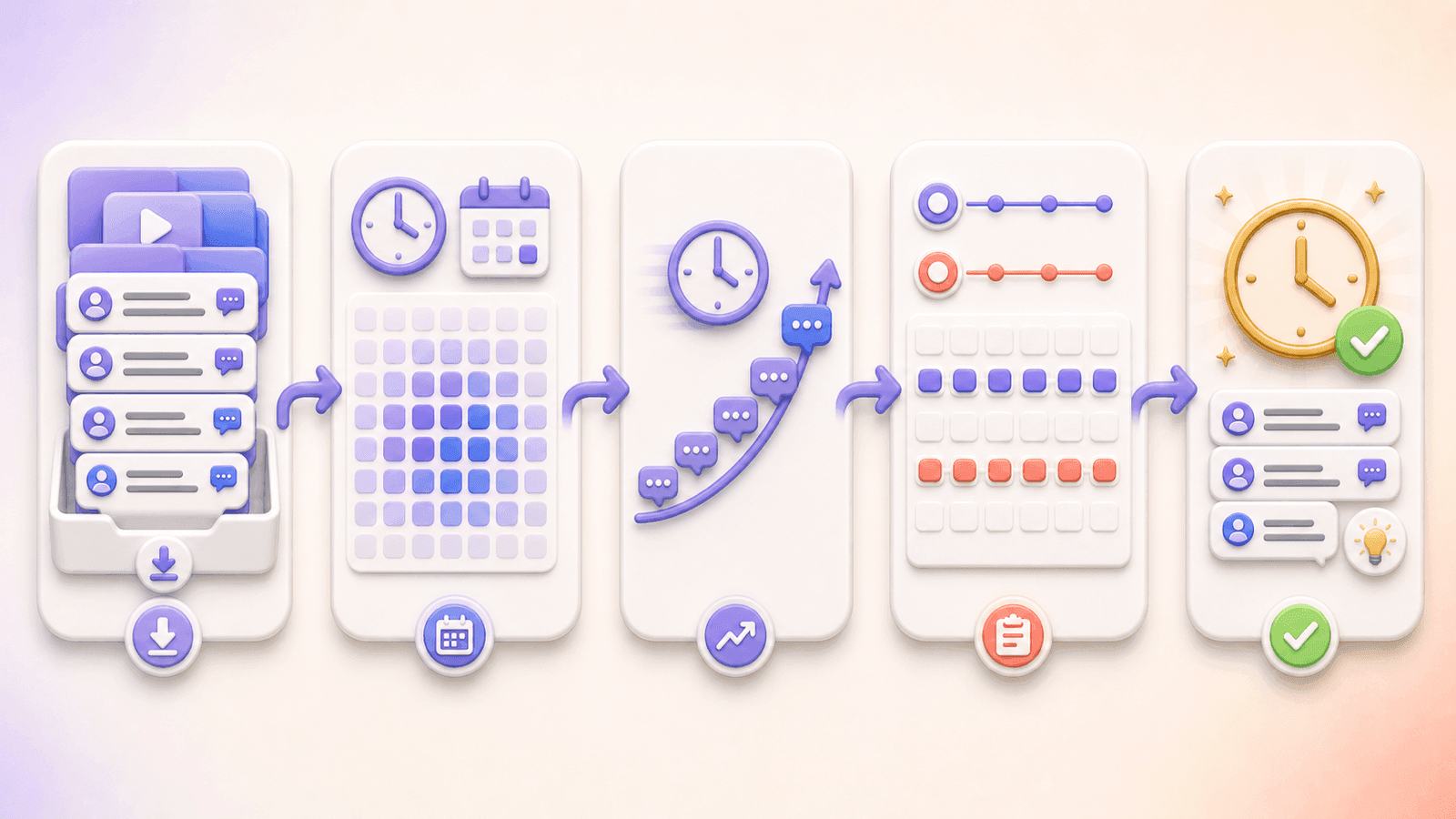
Platform analytics give you a head start. TikTok: Creator Tools → Analytics → Followers → Follower activity shows when your followers are online by hour and day. Instagram: Insights → Total followers → Most active times. Start there.
But follower-activity graphs have a blind spot: they show when people open the app, not when they engage with you. And engagement is what the algorithm's test batch actually measures. That's the gap we built CommentGrid to close — and here's the workflow I recommend to every creator who asks:
- Export your comments. Use the free CommentGrid comment extractor to pull every comment from your last 20–30 TikToks or Reels into CSV or Excel. Each row comes with an ISO timestamp, like count, and author.
- Build your engagement curve. Pivot the timestamps by hour-of-day and day-of-week. In ten minutes you'll see exactly when your audience is motivated enough to type something — the strongest engagement signal there is. Remember: comments are the most time-sensitive metric of all (+51% at peak hours), which makes comment timing the sharpest proxy for your personal peak.
- Measure first-hour velocity. Look at which posts earned the most comments in their first 60 minutes, and what time those posts went live. That intersection is your real best posting time — measured on your audience, not someone else's.
- Cross-check competitors. Export comments from the top-performing videos in your niche and run the same analysis. You'll see when your shared audience is most talkative — and you'll spot the underserved hours they're all ignoring.
- Test for 14 days. Pick your two strongest windows, post comparable content in each, and let first-hour comment velocity — not 24-hour views — call the winner.
Bonus: while you're in there, CommentGrid's AI analysis surfaces the recurring questions, buyer signals, and content requests hiding in those comments — so your best posting time comes with your next ten video ideas attached.
FAQ
What is the best time to post on TikTok today? If "today" is Tuesday, Wednesday, or Thursday, post between 2–6 PM or 7–9 PM in your audience's local time. On Friday, aim for 1–4 PM or after 7 PM. On weekends, late morning (11 AM–1 PM) and 7–9 PM are your safest bets. For a personalized answer, your own follower-activity data beats any table — including ours.
What is the best time to post on Instagram Reels? Weekday midday (11 AM–1 PM) and evenings (6–9 PM), with Wednesday the strongest day and Saturday the weakest. Low-competition windows like early morning can win on raw views but convert to likes at lower rates.
Is it better to post in the morning or at night? For TikTok, night (6–9 PM local) is the only window every major study recommends. For Instagram, both midday and evening work. The exception: niches whose consumption occasion is the morning — fitness, education, news — where 5–9 AM genuinely wins.
Does posting time matter more than content quality? No. Timing moves the needle roughly 15–20% on views; content quality decides whether there's a needle to move. Replying to your own comments, for instance, lifts engagement more (+21% on Instagram in Buffer's data) than perfect timing does. Fix the content first, then fix the clock.
What is the worst time to post on TikTok and Instagram? 1–5 AM in your audience's time zone, on both platforms, in essentially every dataset ever published. Mid-morning weekdays (9 AM–12 PM) are the runner-up dead zone on TikTok.
The studies cited in this post include Buffer (2026, 9.6M+ Instagram posts & 7.1M TikTok posts), Sprout Social (2026, ~2B engagements), Hootsuite (2025, 1M+ posts, 118 countries), Later (11M+ posts), Metricool (2.3M posts), SocialPilot (700K posts), and Adobe Express (2026, 20,247 Reels from 149 top accounts). All figures are observational; algorithms change, so re-check your own analytics quarterly.
Want to stop guessing? Try CommentGrid free — export your TikTok and Instagram comments in minutes, and let your own audience tell you when to post. No credit card required.
 M
MMarshall Sun
Building CommentGrid to decode social conversations. Exploring the signal within the noise of the global social web.