11 min read
Alexandros Kopsialis's Fiat giveaway leads this collection with approximately 42 million comments, followed by Bizarrap's Paulo Londra teaser at 21.8 million and Quel Momento's comment-record challenge at 15.4 million.
The table below ranks 30 notable Instagram posts and Reels by their displayed comment counts. Each entry links to the original post. M means million and K means thousand; posts with the same rounded count are tied at the displayed precision.
30 Highly Commented Instagram Posts, Ranked
The range is striking: a giveaway, a challenge to break a comment record, a music teaser, memorial messages, and personal milestones all appear near the top. To understand what those numbers represent, we looked more closely at six posts and analyzed 15,000 comments across three CommentGrid exports.
Six Posts Behind the Numbers
These six examples show the different reasons a post can become a gathering place for millions of comments. The captions and reporting explain their original context; the comment research that follows examines participation in three exported samples.
Alexandros Kopsialis: A Giveaway With 42M Comments

Kopsialis's post shows him on a Fiat and identifies a paid partnership with La Vie en Rose. C5N's coverage describes a giveaway involving a Fiat 500, an iPhone, and a PlayStation 5.
The prize offer gives readers a concrete explanation for the campaign's appeal. Its comment section also remained active years afterward, making it a useful case for studying how participation changes over a post's lifetime.
Bizarrap × Paulo Londra: A 23-Million-Comment Goal
Bizarrap's caption tied the release of his Paulo Londra collaboration to a clear target: 23 million comments. Infobae reported that fans reached the target in less than 24 hours.
The table uses the displayed count of 21.8M; 23 million refers to the campaign target and reported milestone. The campaign gave fans a shared task with a visible reward: each additional comment helped move the music release closer.
XXXTentacion: “LOVE IS WAR” and Memorial Messages
The upside-down photograph carries the caption “LOVE IS WAR” and displays 10.8M comments. C5N describes the post as a destination for tributes after the artist's death, and messages of remembrance remain visible under it.
This post illustrates another reason comments accumulate: people return to the same photograph to express a continuing connection to an artist.
World Record Egg: A Likes Campaign With Millions of Comments
The egg photo asks people to help break the record for the most liked Instagram post. It has 60.3M likes and 3.8M comments. Guinness World Records identifies it as the previous Instagram likes-record holder before Messi's World Cup celebration.
Its simple, shared goal drew participation around an otherwise ordinary image. Tracking likes and comments separately shows the different ways people took part in that challenge.
Alexander Sørloth: Fans Asking for a Return
Sørloth's Norway training photo has 3M comments. Anadolu reported that Trabzonspor supporters flooded the post with requests for him to return to the club. “Come to Trabzonspor” still appears among the visible comments.
The photograph became a place for supporters to repeat a common request. The post's subject and the audience's chosen message were different—a useful distinction when reviewing what people want from a creator or brand.
Lionel Messi: World Cup Celebration, 2.2M Comments
Messi's World Cup celebration carousel has 2.2M comments and 74.5M likes. Guinness documented its Instagram likes record, reflecting the scale of the response to Argentina's win.
The comments ranking puts that achievement in perspective: likes and comments measure different actions and produce different rankings. For our detailed Messi comment analysis, we used the separate airplane photo with the trophy, also linked in the table.
What We Found in 15,000 Exported Comments
We used CommentGrid to export three samples of 5,000 top-level comments each, with replies excluded and Instagram's default display order. We then calculated account counts and reviewed comment text and timestamps.
| Exported Sample | Comments Analyzed | Distinct Commenting Accounts |
|---|---|---|
| Kopsialis giveaway | 5,000 | 1,822 |
| Bizarrap music teaser | 5,000 | 1,385 |
| Messi airplane photo | 5,000 | 3,736 |
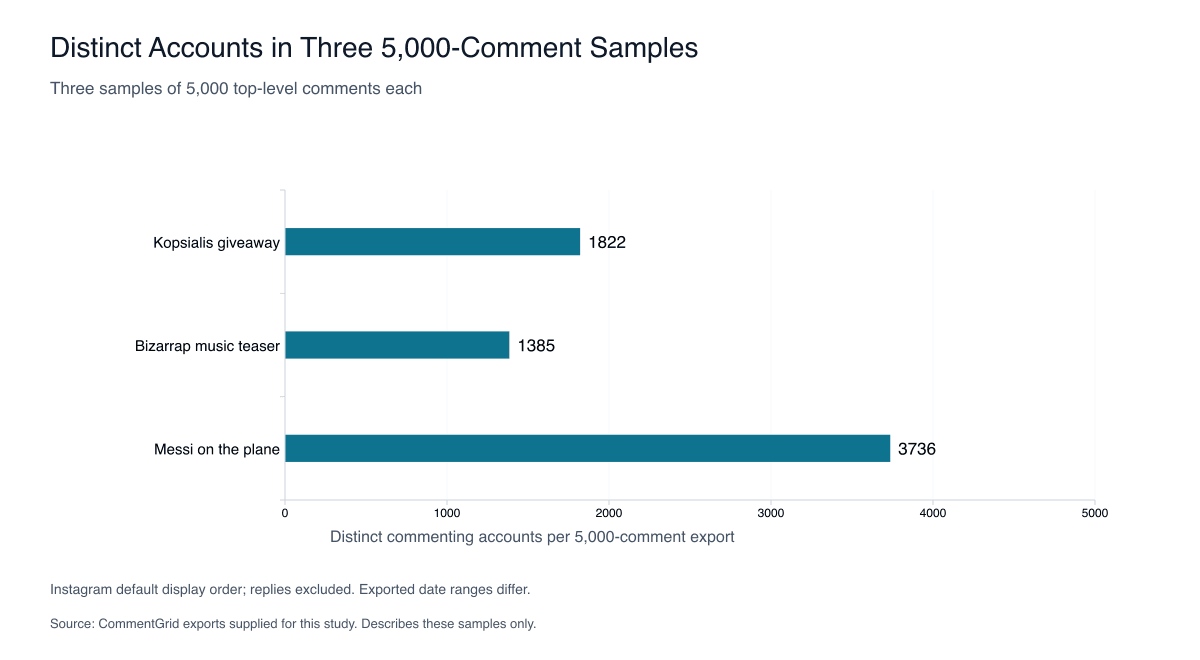
Account counts describe the usernames present in each export. The samples cover different periods in the posts' histories.
The same volume of comments can come from very different numbers of accounts. Reading the comments adds another layer: it reveals what people are contributing and whether those contributions relate to the original post.
Case Study 1: A Giveaway Post Can Outlive Its Original Campaign
Every comment in our Kopsialis export was posted more than five years after the giveaway began. That makes this sample a view of the post's lasting activity.
Two patterns stood out:
- 3,068 comments—61.36% of the sample—contained the Uzbekistan flag emoji, 🇺🇿. They came from 1,037 accounts.
- 4,248 comments—84.96%—contained only symbols, emoji, or punctuation. Another 603 contained letters or numbers, and 149 had no exported text.
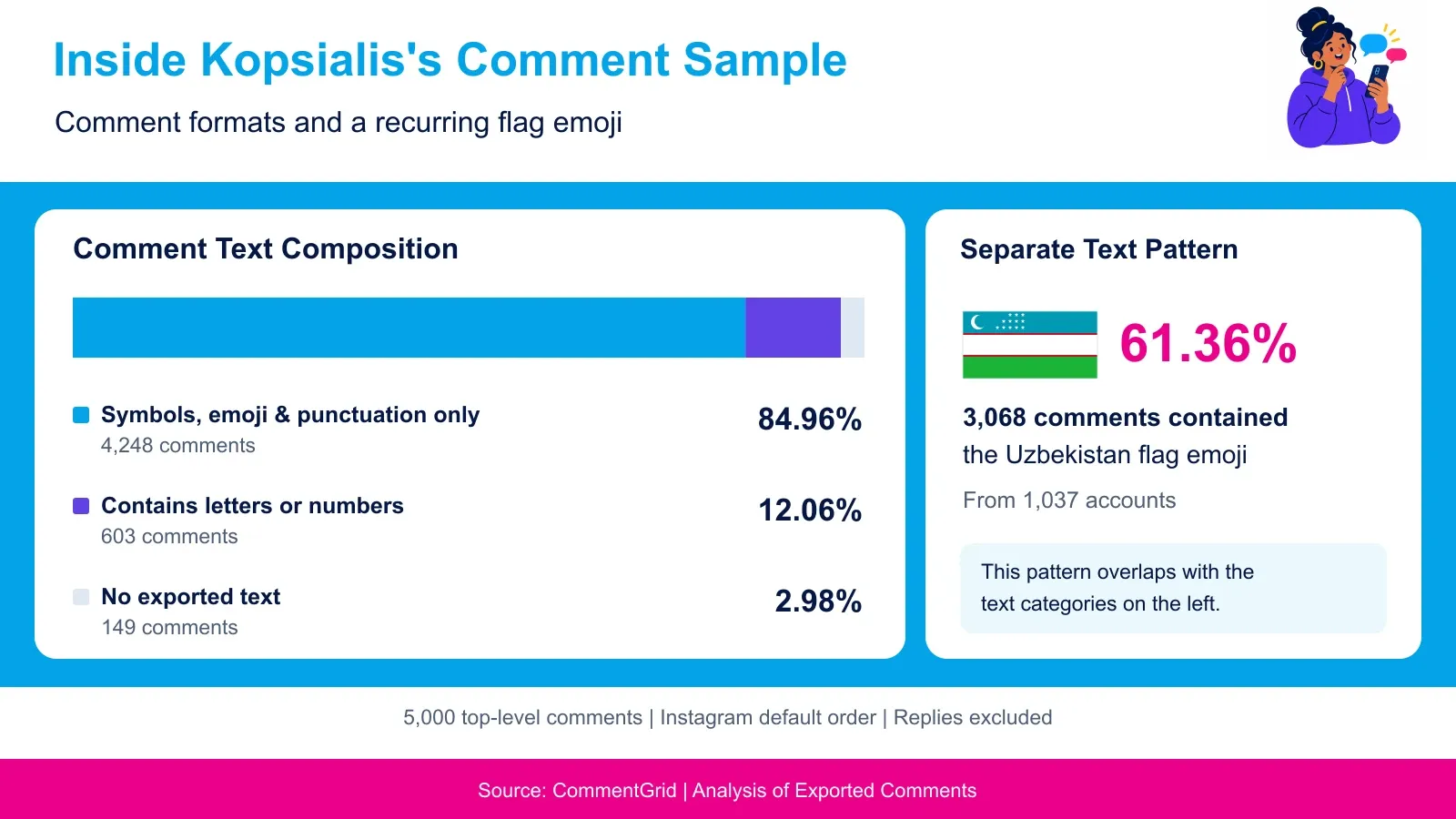
The flag count describes what appeared in the comments, rather than the commenters' nationality. Flag-containing comments can also be symbol-only comments, so the two percentages overlap.
A contextual review of 60 randomly selected comments containing letters or numbers also found reactions to the enormous comment count itself. Alongside the recurring flags, these reactions show how the discussion had developed beyond the original prize offer.
The post's long-term activity had become a subject worth studying in its own right. For brands reviewing an older campaign, grouping comments by period and recurring content helps separate launch participation from later activity. That distinction gives a more useful picture of a post's continuing participation than its total count alone.
Case Study 2: Text and Timing Reveal a Shared Promotion
Messi's airplane photo with the World Cup trophy has about 461.7K comments. Its 5,000-comment export contained 3,736 distinct accounts.
Within that sample, we found 176 comments promoting the same social-media service, posted by 174 accounts in seven minutes and 23 seconds.
| Observation | Result Within the Export |
|---|---|
| Comments in the identified promotional group | 176 |
| Share of the analyzed sample | 3.52% |
| Distinct accounts posting them | 174 |
| Time from first to last matching comment | 7 minutes, 23 seconds |
| Matching comments reviewed in context | All 176 |
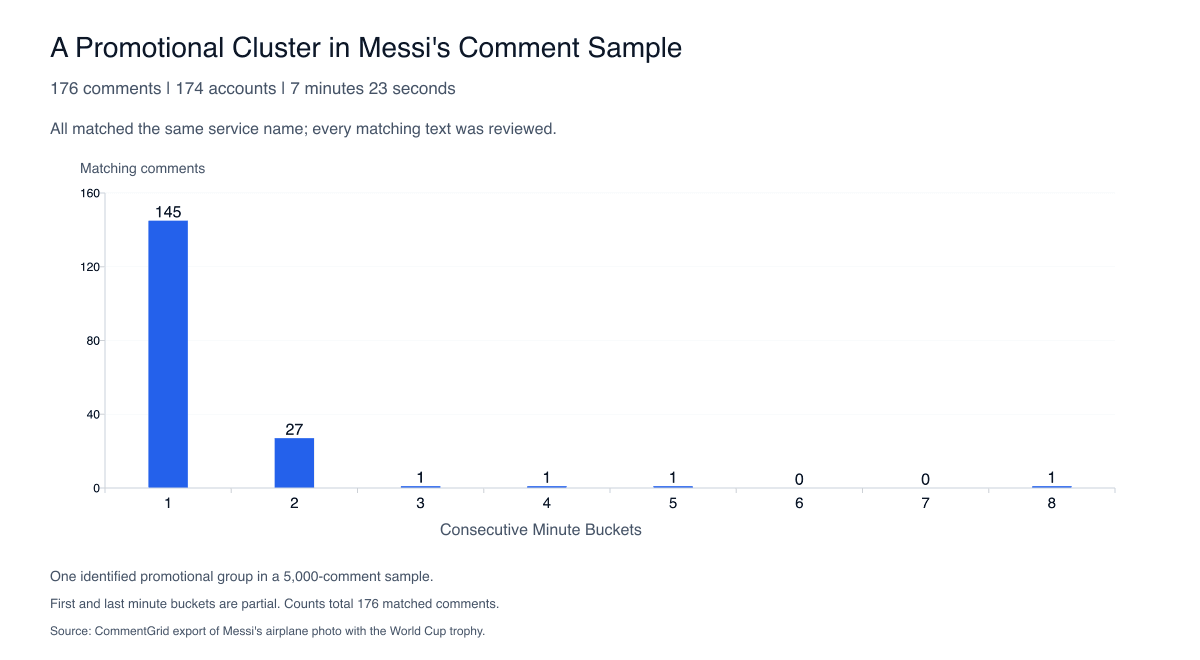
The chart shows the identified promotional group within the export. The first and last minute buckets are partial.
We noticed a recurring service name, searched for it throughout the file, and read every matching comment. The messages advertised followers, likes, and views rather than discussing the photograph. The service name and commenter handles are omitted here.
Deduplicating this promotional group by account would still leave 174 of its 176 comments. Grouping by repeated text and posting time made the shared promotion visible.
For audience research, separate unrelated advertising from reactions to the post before summarizing themes. This makes the resulting analysis more useful for finding genuine questions, feedback, and content ideas. Here, text review identified a concrete promotional group that an account count alone would have missed.
Supporting Example: Repeat Participation Drove Most of Bizarrap's Sample Volume
In the Bizarrap sample, 516 accounts that commented at least twice contributed 4,131 comments—82.62% of the 5,000 records. Another 869 accounts contributed one comment each.
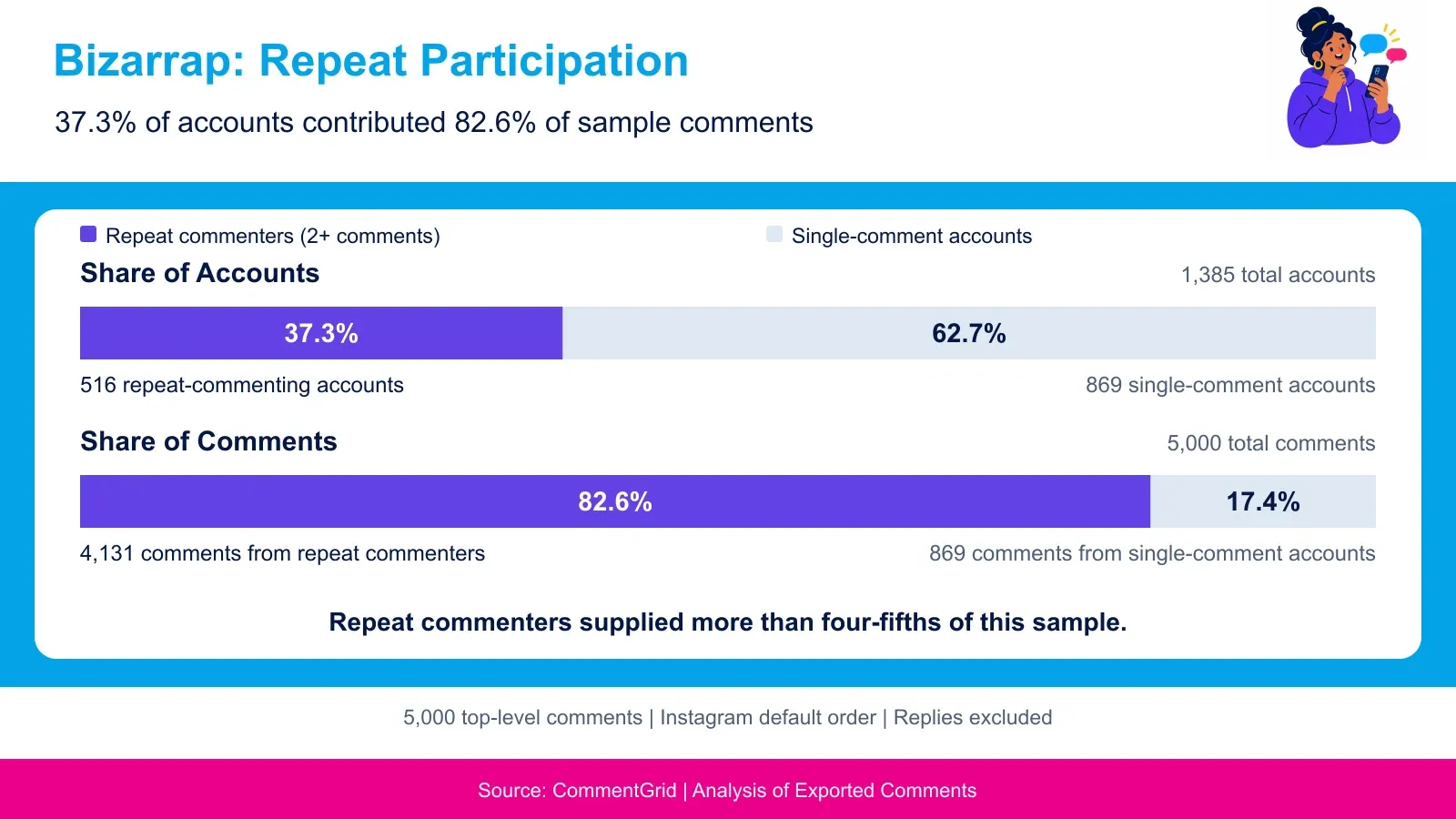
That leaves two useful measures of participation: 5,000 comments from 1,385 distinct accounts. The larger number captures activity; the account count shows how many usernames contributed it.
Repeat participants supplied more than four-fifths of the comments in this sample. When reviewing a comment-driven campaign, report both comment volume and participating accounts. Keeping repeated contributions makes it possible to see how much of the activity comes from people returning to comment again.
What Creators and Brands Can Learn
A giveaway, a release challenge, a memorial, and a sporting celebration can all attract large comment counts. The useful question for a brand is what those comments reveal about participation.
The three exported samples suggest practical checks:
- Look at the stage of the conversation. Kopsialis's sample showed activity years after the giveaway. Compare comment dates with the event you want to understand, then study the relevant period.
- Count accounts as well as comments. Bizarrap's sample showed how strongly repeat participants contributed to volume. Both measures belong in a campaign review.
- Read recurring messages in context. In the Messi sample, many accounts promoted the same unrelated service. Separating that group helps keep an audience summary focused on responses to the post.
For your own content, start with a question that leads to action: Which giveaway instruction needs clarification? Which product question comes up repeatedly? Which topic deserves a follow-up post? Those questions give the export and analysis a clear purpose.
How to Analyze an Instagram Post With CommentGrid
Start with a supported public post or Reel. The Instagram Comment Extractor provides an entry point for reviewing and downloading available comments. This study used XLSX exports.
- Keep the post context with your notes. Save the direct URL, caption, displayed comment count, and any campaign rules.
- Export the comments. Keep the original file, and check the returned records, their date range, display order, and whether replies are included.
- Connect each question to a field. Use
Usernameto count participating accounts,Comment Textto review recurring messages, andDateto examine timing. TheLikesfield in a comment export describes likes on that comment. - Turn recurring themes into next steps. CommentGrid's AI Comment Analysis offers summaries of themes, sentiment, questions, and content ideas. Review the source comments alongside those summaries to decide what to answer, clarify, or create next.
For a walkthrough, see how to export Instagram comments. The custom metrics in this article were calculated and reviewed from exported records; the product's AI analysis is a separate workflow for exploring comment themes.
Research Method
The opening table is a curated collection of 30 high-comment public posts and Reels, ordered by the totals displayed on their original Instagram pages. It is not an official or exhaustive global ranking. We matched each original link to its account and content, using direct page readings and retained original-page evidence. Counts keep Instagram's displayed precision, including rounded ties. Historical reporting supplies background for the six featured posts.
The comment analysis uses three default-order samples of 5,000 top-level comments each. Replies were excluded. Each file contained 5,000 distinct comment IDs, with complete usernames and parseable dates. Genuine repeated contributions from an account were retained; usernames were trimmed and compared without case differences.
For text analysis, “symbol-only” means nonempty text with no Unicode letters or numbers. Blank text was counted separately, including records that may represent media comments. The Kopsialis flag search covered all 5,000 records. We also reviewed 60 randomly selected text-containing comments per export for context, then searched the full Messi export for the recurring service name and reviewed all 176 matches.
All percentages describe their stated samples. Default display order produces a non-random selection, and the three exports cover different periods after their posts' launches. Findings therefore describe the exported comments rather than estimating each post's full history. The promotional grouping is based on content and timing, with no inference about account automation or ownership.
Frequently Asked Questions
What Is the Most Commented Post on Instagram?
Alexandros Kopsialis's Fiat giveaway leads the verified posts in this collection with approximately 42M comments. Bizarrap's Paulo Londra teaser follows at 21.8M, then Quel Momento's comment-record challenge at 15.4M. The table links directly to each post.
Does the Most Liked Instagram Post Also Have the Most Comments?
Likes and comments produce different rankings. Messi's World Cup celebration has 74.5M likes and 2.2M comments, while Kopsialis's giveaway has 554.5K likes and 42M comments. A likes record measures a different kind of participation.
Is the Most Liked Instagram Comment the Same Record?
No. That record concerns likes received by one comment. The most commented Instagram post is measured by the number of comments under a post.
Do Millions of Comments Mean Millions of Different People?
One account can leave multiple comments, and one person may use multiple accounts. In our Bizarrap sample, 5,000 comments came from 1,385 usernames. Counting both comments and accounts gives a clearer picture of participation.
Why Do Giveaways and Comment Challenges Attract So Many Comments?
They give people a specific reason to participate, such as entering a prize draw or helping unlock a release. Bizarrap's caption connected a shared comment target to new music; Quel Momento explicitly invited people to help break a comment record. Review the actual participation rules and comment patterns when comparing campaigns.
How Can I Analyze the Comments Under an Instagram Post?
Export available comments with CommentGrid, then review recurring messages, participating accounts, and posting times. Use comment analysis to identify questions and themes, and check the source comments before deciding what to address. The strongest result is a concrete next step, such as clarifying instructions or answering a repeated product question.
Find Out What People Are Saying Under Your Posts
Use CommentGrid to explore available comments, review recurring themes, and check the source comments before deciding what to address next.
Explore Comment Analysis M
MMarshall Sun
Building CommentGrid to decode social conversations. Exploring the signal within the noise of the global social web.