10 min read

For this CommentGrid study, we analyzed an exported dataset of 1,001 replies to Vice President JD Vance's post about Republicans' 2026 midterm defeat. We wanted to understand what the discussion added to the explanations emerging after election night.
Why did Republicans lose the 2026 midterms? The comments point to a possible connection between the Iran war, pressure on household budgets, and anger over promises voters believed the administration had broken. They also expose disagreements about responsibility: some blamed Trump, others blamed Senate Republicans, and some challenged Vance's own credibility.
Those are possible explanations to examine alongside broader election evidence. The commenters' voting histories are unknown, and this sample cannot establish why the country voted as it did.
What happened in the 2026 midterm elections
ABC News projected that Democrats would take control of the House and Senate following the November 3 elections. This was a congressional midterm election, rather than a presidential contest. ABC News election coverage.
In his November 4 post, Vance argued that Republican turnout had held up better than the results suggested. His explanation was that some people who backed Trump and Vance in 2024 had shown up and voted for Democrats.
Vance cited an unnamed pollster who identified four priorities among voters who had abandoned the party: ending the war, addressing living costs and inflation, putting America first, and changing the relationship with Israel. He then made the war his central explanation.
These were Vance's claims about polling. His post did not include the underlying survey, question wording, or data needed to assess how much each factor contributed.
The replies provide another kind of evidence: how people reacted to that explanation, including the reasons some found it incomplete.
What we analyzed
The supplied export contains 1,001 unique reply IDs from 969 distinct account IDs. The sampled replies were posted on November 4, 2026, between approximately 10:44 a.m. and 11:40 p.m. U.S. Eastern Standard Time (EST).
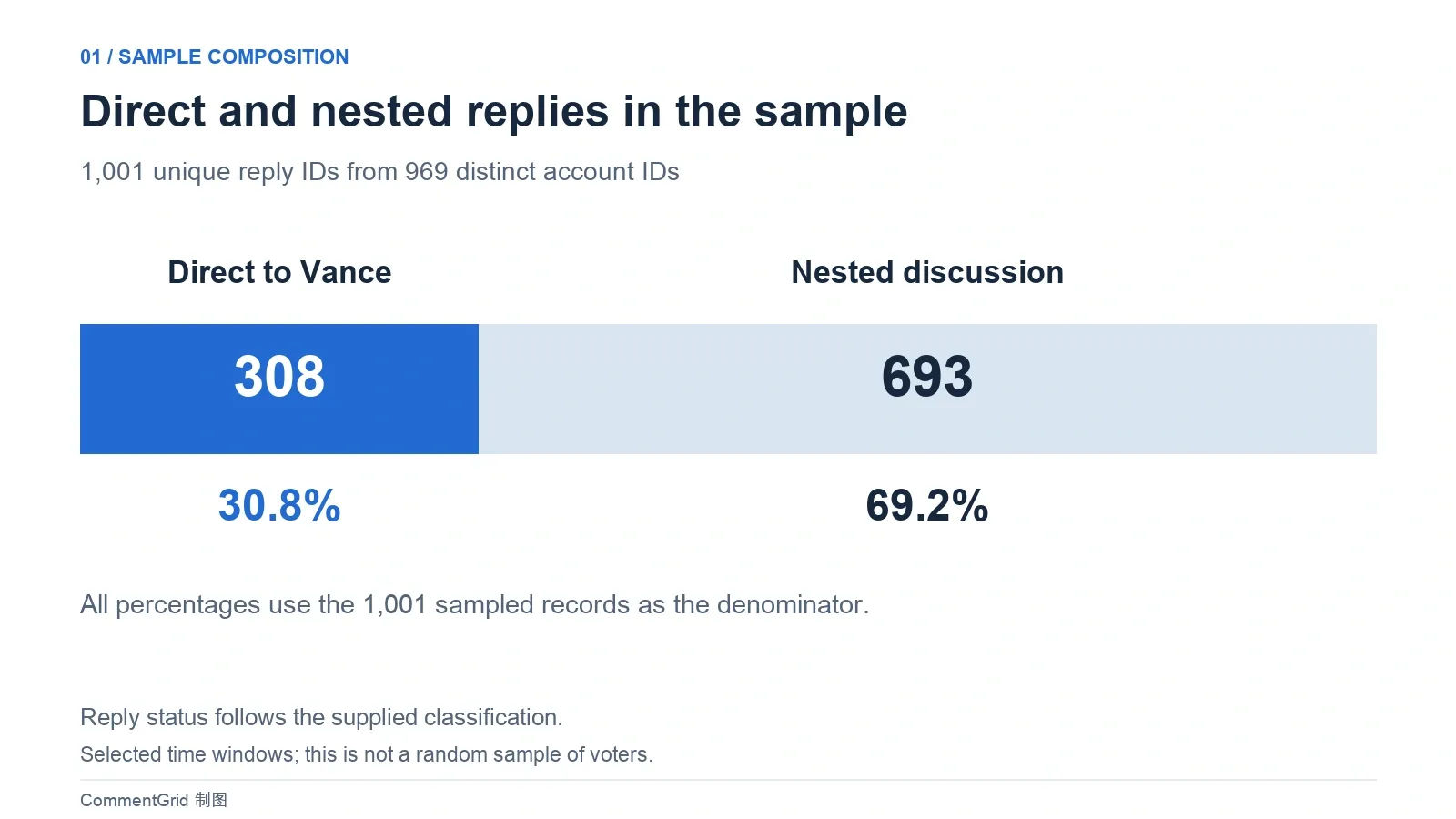
Figure 1. Of the 1,001 sampled records, 308 were marked as direct replies (30.8%) and 693 as nested replies (69.2%). Classification follows the supplied export.
The source report describes collection through the X API using multiple time windows, with extra attention to early highly liked replies and busy periods. This is a selected conversation sample. It is not a random sample of voters or a complete export of the thread.
We used the supplied topic labels to navigate the dataset and checked the original text of the comments discussed below. Likes are the counts recorded in the export, not live totals.
The Iran war raised questions about broken promises
The sharpest disagreement was often about accountability. Some replies accepted that the war had hurt Republicans while rejecting Vance's attempt to explain the defeat after the event.
One direct reply, with 178 recorded likes, opened:
Too little too late.
You didn't oppose the war either.
That criticism raises a question a campaign postmortem can miss. Identifying an unpopular policy does not resolve voters' objections to the officials they associate with it. A promise to change direction may be less persuasive when the same people are explaining why the previous direction failed.
Other replies challenged the decision to start the war, rather than just its duration. That distinction matters. Ending a conflict may answer a policy demand while leaving the credibility problem unresolved.
The discussion was divided, however. A reply with 336 likes urged the administration to finish the war and accelerate other priorities. Another listed failure to finish the job in Iran among the reasons for defeat.
The useful finding is a disagreement over both the policy and the government's judgment. A count of comments mentioning war would combine people who wanted to end it with people dissatisfied with how it was conducted. It would not tell us how many supported either position.
Living costs connected foreign policy to everyday dissatisfaction
Economic frustration gives the war explanation a possible domestic mechanism. If voters connect events abroad with the prices they encounter at home, foreign policy becomes part of their assessment of the government's economic performance.
A direct reply with 1,352 likes linked opposition to another prolonged war with reminders at the gas pump and grocery store. Its criticism also extended to the administration's response to public frustration.
Another reply with 78 likes reduced the complaint to:
eggs still $5 goofy
That is a commenter's complaint, rather than a verified national egg price. Its relevance is the way it frames the election: through a familiar household purchase.
The broader economic explanation has evidence beyond this thread. Reuters reported that nearly nine in ten respondents in election exit polling considered living costs a crucial or major voting factor. About two-thirds blamed Trump for high prices. Those results describe the surveyed electorate, a different population from this comment sample. Reuters exit-poll report.
Our interpretation is that the replies help explain how these concerns can reinforce one another. A voter can object to a war, feel financially squeezed, and view the combination as evidence that leaders have misplaced their priorities.
The discussion also contained competing economic explanations. One reply with 338 likes blamed protectionism. A different commenter disputed the connection between the conflict and everyday prices. The thread cannot isolate the effect of war from tariffs, other economic pressures, or voters' existing political views.
Anger at Senate Republicans revealed a separate argument about delivery
Vance's explanation faced a different challenge from commenters who blamed Republican legislators for failing to deliver the party's agenda.
The second most liked direct reply in the sample, with 9,533 likes, accused John Thune and Senate Republicans of blocking legislation. It began:
You didn't get the SAVE ACT passed and John Thune blocked all the House legislation.
That is the commenter's account, not a verified legislative history. It shows what that reply's author believed the party had failed to do.
Another direct reply with 157 likes argued that Republican control of both chambers had produced only a fraction of what supporters had been promised.
These comments suggest a different possible source of disillusionment: the distance between winning office and delivering results. For someone who holds that view, a debate over campaign messaging may seem beside the point. The demand is for visible action.
But those demands do not automatically describe what would attract independents or people who voted Democratic. A policy that satisfies an angry party supporter could have a different effect on a persuadable voter. This thread offers no basis for assuming the same remedy would work for both.
The replies showed competing ideas of America First
Vance presented putting America first as one route back to dissatisfied voters. The replies illustrate how differently people can interpret that phrase.
Some connected it with avoiding foreign wars or changing foreign relationships. Others focused on domestic employment, immigration enforcement, or legislation. A direct reply with 3,155 likes, for example, criticized the treatment of American engineering graduates and argued that domestic workers were being overlooked.
We have not verified its labor-market claims. The relevant observation is the author's expectation that Republican policy should visibly prioritize American workers.
At the same time, a reply with 1,257 likes offered a much broader rejection:
You lost because of Trump.
And you will keep losing because of him.
These responses belong to different arguments. Some criticize a failure to implement the party's promises. Others reject the president or the administration's choices. Agreement that Republicans performed badly does not imply agreement about the alternative.
For readers asking why Republicans lost, this is a useful limit on any single explanation: the same election result can reflect several groups withdrawing support for different reasons. The comments illustrate that possibility, although they cannot measure the size of those groups in the electorate.
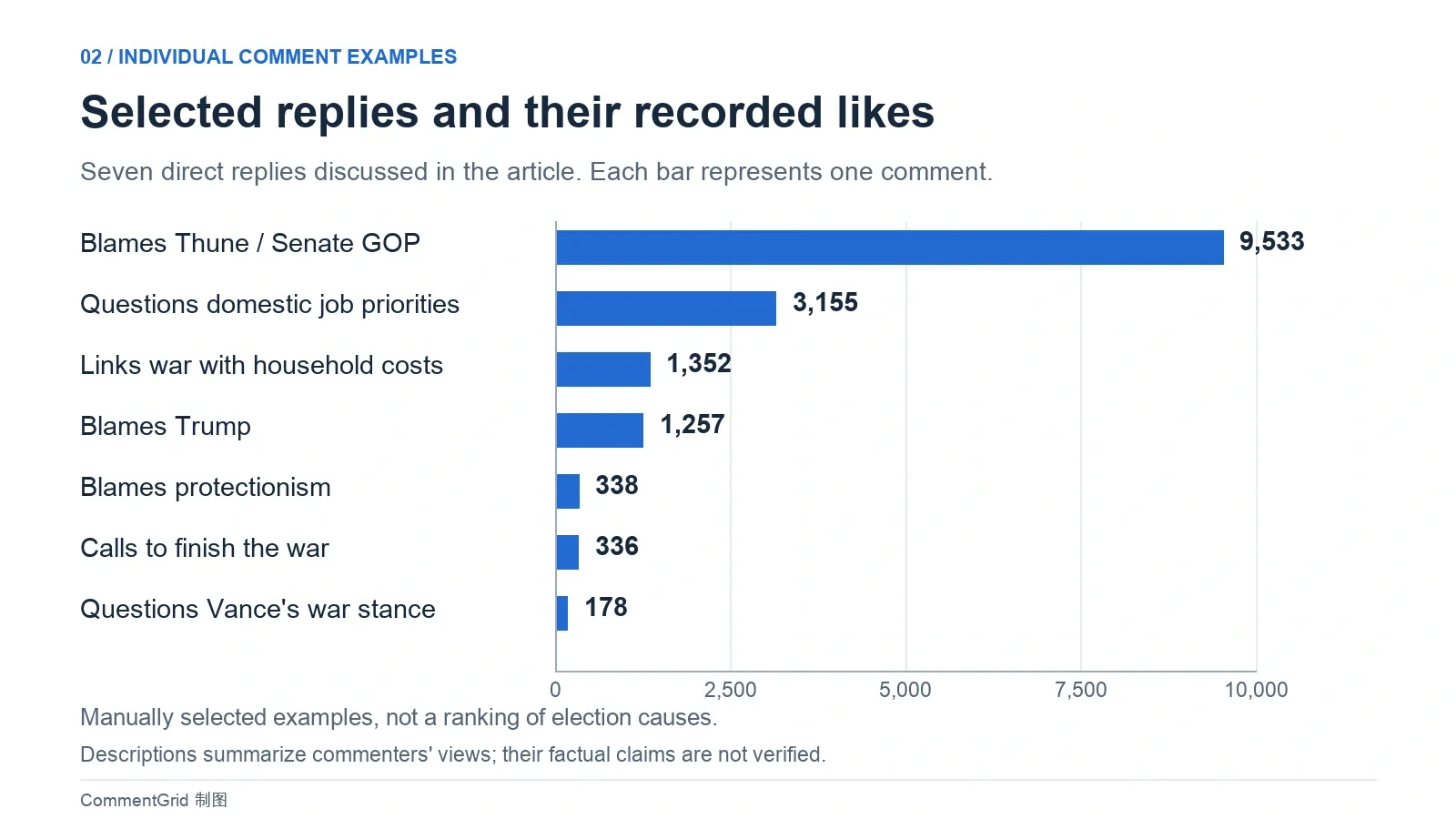
Figure 2. Recorded likes on seven direct replies discussed above. These examples were selected manually. The labels summarize individual comments, rather than aggregated support for a policy position.
Turnout and switching parties require different evidence
Vance's distinction between turnout and vote choice deserves scrutiny. A campaign can successfully encourage people to vote while losing their support on the ballot.
If previous supporters stayed home, mobilization could be part of the problem. If they voted for the other party, the questions shift toward persuasion, policy, and trust. Both can happen in different places during the same election.
The comments cannot establish which happened more often. Following Vance, replying to his post, or criticizing him does not prove that someone voted Republican in 2024. Even a comment claiming a past vote would remain an unverified self-report.
Estimating the contribution of switching would require evidence such as surveys following the same voters across elections, alongside turnout and geographic election data. Vance's account raises the hypothesis. This thread does not independently confirm it.
Highly liked criticism showed attention rather than a voter majority
The ten most liked direct replies in the supplied sample were all critical or mocking. That makes them useful for examining which objections attracted engagement in this conversation.
It does not establish that most voters shared those objections. The sampling method deliberately sought early highly liked responses, and one reply accounted for 64,623 of the 99,111 likes recorded across all sampled replies, about 65.2%.
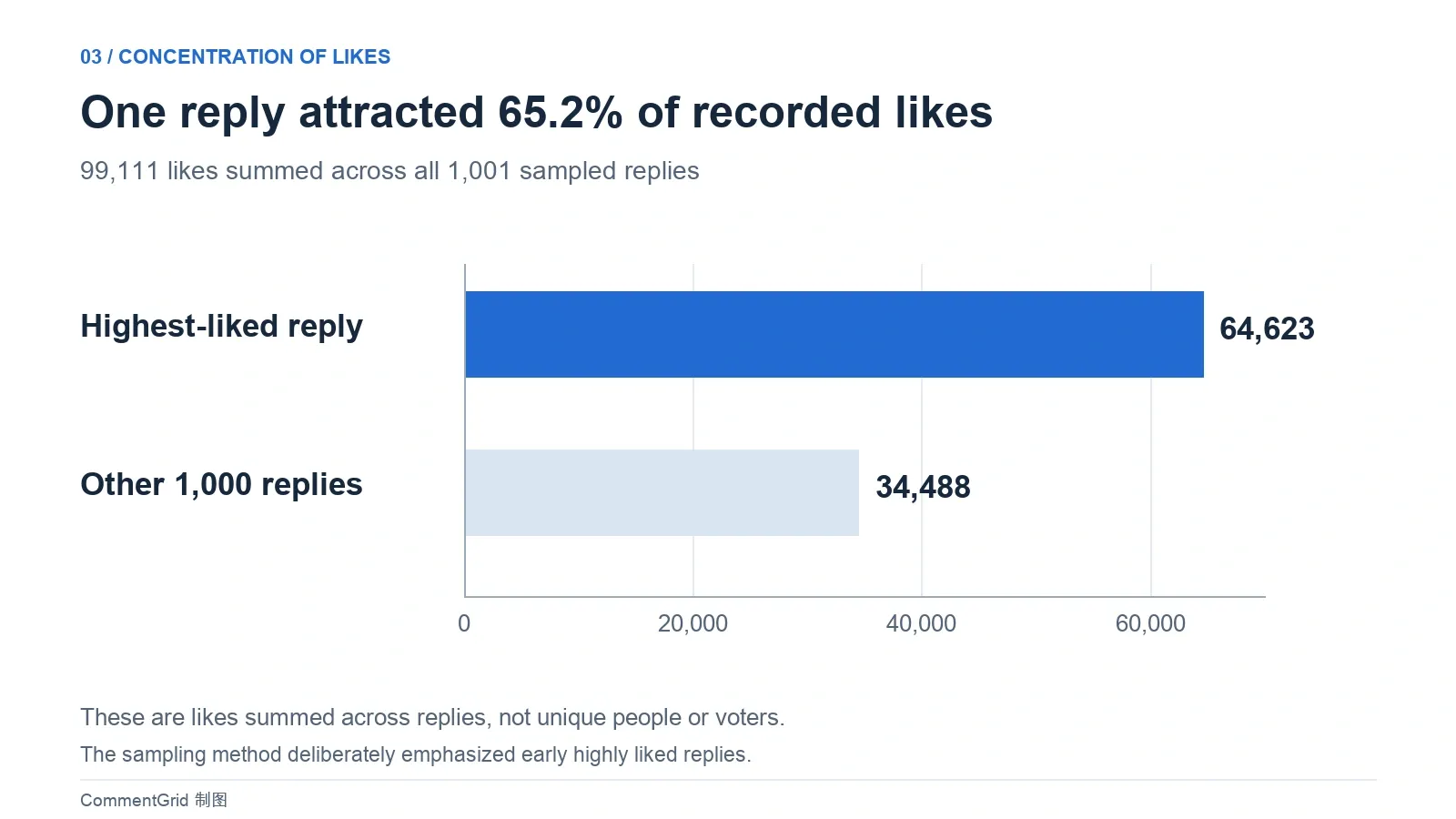
Figure 3. The highest-liked reply received 64,623 likes, compared with 34,488 across the other 1,000 replies. These totals sum likes on individual records, rather than counting unique people.
The source report identifies that reply as a dismissive meme. The spreadsheet itself contains a shortened media link, rather than the image text. We therefore do not use its purported wording to explain the election.
There is a related problem with the supplied sentiment labels. A reply praising another commenter may be labeled positive without supporting Vance. A supportive passage can be labeled neutral. For this article, we use specific comments and their context rather than treating those labels as an approval rating.
The clearest conclusion is narrower: several critical responses attracted substantial engagement in this selected sample. Engagement tells us something about the conversation's reception. It cannot tell us how many votes an argument changed.
What the comments add to explanations of the Republican defeat
The replies make a plausible connection between unpopular decisions, household frustration, and damaged trust. They also show why simply naming an unpopular policy may fail to satisfy people who hold the administration responsible for adopting it.
Broader voting evidence is needed to judge the scale of each cause. The contribution of this comment study is to make the objections concrete: dissatisfaction over the war, complaints about living costs, frustration with legislative delivery, and disagreement about who deserves the blame.
That leaves a more useful question than whether Republicans needed a sharper slogan: which voters stopped trusting them to deliver, and what would those voters consider evidence of improvement?
Frequently asked questions
Did Trump lose a presidential election in 2026
No. The 2026 contest was a midterm election. References to Trump losing the midterms concern his party's performance and its control of Congress.
Did the Iran war cause Republicans to lose the midterms
Vance identified it as the main reason. The sampled replies show that the war was a contested explanation, often discussed alongside prices and broken promises. They cannot establish its independent effect on the election result.
Do the comments prove that Trump voters switched to Democrats
No. The dataset does not verify commenters' locations, eligibility, or voting histories. Vance made that argument, but measuring switching requires broader voter research.
Study method and sources
This analysis uses a supplied X API export and accompanying report, reviewed on November 5, 2026. The workbook contains 1,001 unique reply IDs and 969 distinct account IDs. Direct-reply status follows the supplied classification, which the report says combines relationship fields with heuristics.
Collection covered selected time windows and emphasized early highly liked replies and busy periods. Some exported texts appear shortened, and media content is not fully represented in the text fields. Quotations above use text present in the export. We have not independently validated every comment's factual claims, account authenticity, or the original collection process.
The evidence supports an analysis of this conversation and possible explanations to investigate. It does not support a national sentiment estimate, a verified profile of former Republican voters, or a causal allocation of the election losses.
To study a discussion on Instagram, TikTok, Facebook, or YouTube, CommentGrid can help export comments, while its comment analysis tools help identify recurring themes and sentiment. Keep the original comments available so you can check what each conclusion rests on.
 M
Marshall Sun
Building CommentGrid to decode social conversations. Exploring the signal within the noise of the global social web.