12 min read
Imagine you walk into a casino. Your chips are likes, shares, saves, comments. Each table has a different dealer. At TikTok, the dealer only cares: did you keep the crowd glued to their seats? At Instagram, they're gossiping about who your best friends are. Over at YouTube, the pit boss judges your entire career, not just tonight's performance. And at X? The dealer is obsessively eavesdropping on every conversation your chips start.
Welcome to social media in 2025-2026. Your engagement rate isn't a vanity metric. It's the hard currency that decides whether the algorithmic house lets you win or shows you the door.
I've spent the last few years building CommentGrid, a tool that helps creators and analysts export and analyze social media comments. In that time, I've watched the algorithmic goalposts shift more times than I can count. So let's cut through the noise and talk about what actually moves the needle on each platform. And why most KOLs are sitting on a goldmine they're completely ignoring.
TikTok: The Attention Span Casino
Let's start with the platform that terrifies every other platform: TikTok.
TikTok's algorithm is like a talent scout with severe ADHD and a stopwatch. It doesn't care who you are. It cares what you do in the first three seconds. That opening hook? It's your survival mechanism. Full stop.
Here's the data that should keep every KOL up at night: watch time and completion rate account for roughly 40-50% of TikTok's ranking signals (softomatesolutions.com). The algorithm feeds your video to a small test pool, maybe 200-500 people. If they swipe away before the halfway mark, your content dies. Quietly.
If they stay, though. If they watch twice. If they share it. The algorithm opens the floodgates. Your video graduates from 500 people to thousands, tens of thousands, millions. Brutal. Meritocratic.
TikTok ranks engagement like this: shares beat saves, saves beat comments, comments beat likes (UpNumbers - Buy Followers, Likes & More | 100% Safe & Reliable). A like costs zero effort. A share costs social capital. The algorithm knows the difference.
So what should you actually do? Your first three seconds are your entire pitch. Treat them like a movie trailer. Optimize for the share, not the like. Ask yourself: would someone send this to their best friend unprompted? If not, rewrite it.
Instagram: The Friendship Algorithm
Instagram spent 2025 undergoing an identity crisis. It wanted to be TikTok (hello, Reels), but it also remembered it's supposed to help people connect with friends. The result: a dual-track algorithm trying to discover new content and strengthen existing relationships.
In the Feed, the algorithm's number one ranking factor is now relationship strength (Free Influencer Marketing Platform). It calculates a "friendship score" based on how often you interact. Not just likes and comments, but DMs, Story replies, profile visits, and how long you linger on their content. If you've ever wondered why your best friend's lunch photo shows up before a viral Reel from a stranger, that's why.
But in the Reels tab and Explore page, the algorithm switches personalities entirely. Suddenly it's in discovery mode, hunting for entertaining content it can show to non-followers. Reels get about 2-3x the organic reach of static posts and carousels (Kept Secret in Performance Content). That makes them the go-to format for audience growth.
Here's where it gets interesting for engagement strategy. Instagram carousels average 6.90% engagement. Reels sit at 3.31% (Socialinsider). Carousels get better interaction depth (more saves, more thorough engagement). Reels get better reach. The smart KOL uses Reels as the fishing net and carousels as the relationship builder.
Oh, and one more thing: the first 30-60 minutes after posting are everything (Free Influencer Marketing Platform). Instagram's algorithm is now heavily weighting early engagement velocity. A post that gets 100 interactions in its first hour gets dramatically more distribution than a post that gets the same 100 interactions spread across 24 hours. Rocket launch physics. You need escape velocity in that first window, or you never make it to orbit.
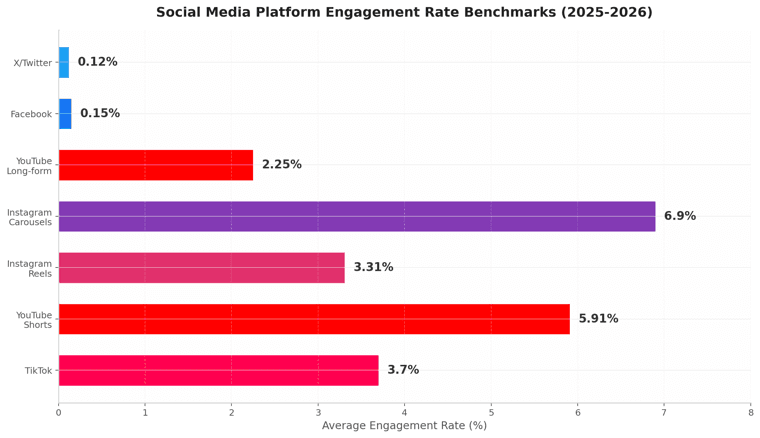 *Figure 1: Not all platforms are created equal. Your "good" engagement rate on TikTok might be a disaster on Instagram Reels, or vice versa. Source: Socialinsider, Quid, Buffer (PostEverywhere) (Socialinsider) *
What to do about it: Post when your audience is most active. Reply to every early comment like your distribution depends on it, because it does. Use a dual strategy: Reels for reach, carousels for depth. Not sure where you stand? Plug your numbers into our free Instagram Engagement Rate Calculator and find out if you're beating the benchmark or getting beat by it.
YouTube: The Long Game Investor
YouTube's algorithm underwent the most dramatic shift of any platform in 2025. It moved from evaluating individual videos to evaluating entire channels (SocialBee). The difference between grading a single test versus evaluating a student's entire academic career.
This is huge for KOLs. You can't just chase one viral hit and coast. You need consistency: quality, topic focus, upload schedule. The algorithm is building your "topical authority." If you're all over the place, it gets confused and stops recommending you.
The core signals haven't changed much though. Average View Duration (AVD) and Click-Through Rate (CTR) are still king. If your AVD drops below 40%, the algorithm basically puts you in timeout (Dataslayer). A healthy video targets 4-10% CTR on its thumbnail and title, combined with the highest possible AVD.
But here's the underappreciated signal: session contribution. YouTube cares deeply about whether your video keeps people on the platform. If a viewer watches your video then clicks to another, especially one of yours, you get rewarded. If they close the app? That's a negative signal. It's like being at a party. You're judged not just by how fun you are, but by whether people stick around after talking to you.
YouTube Shorts have become a powerful discovery tool too, with engagement rates hitting 5.91% (Marketing Agent Blog). Creators who combine Shorts and long-form see 41% faster channel growth (Marketing Agent Blog).
What to do about it: Think in series, not singles. Create playlists. End every video with a callout to related video. Treat your Shorts as a trailer for your long-form content, the free sample that gets people to buy the full meal.
X (Twitter): The Conversation Engine
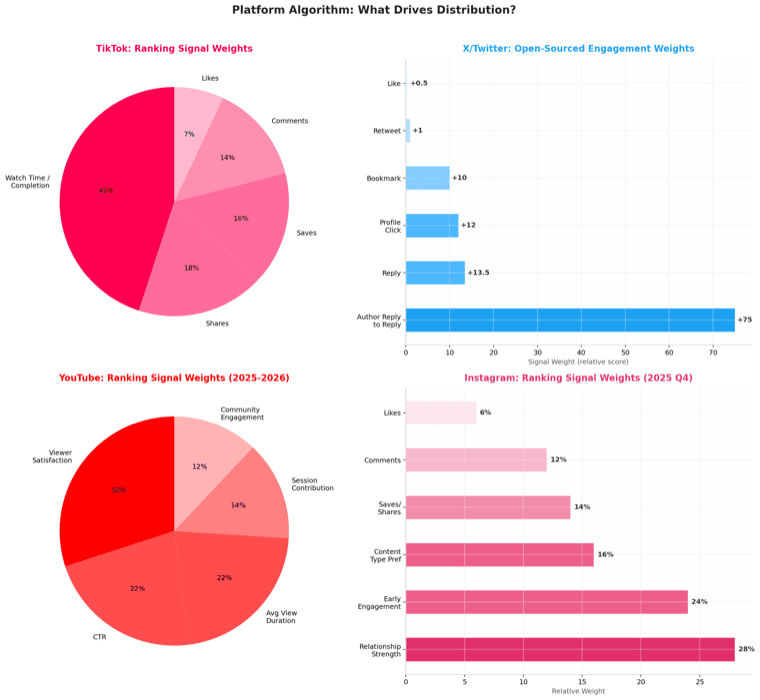 *Figure 2: What each platform's algorithm actually cares about. Notice how X values replies 150x more than likes, while TikTok obsesses over watch time. Source: X open-sourced algorithm code, industry analysis (PostEverywhere) (softomatesolutions.com) *
X is the weirdest platform on this list, and I say that with affection. It's also the most transparent. Elon open-sourced the algorithm, so we can literally see how it thinks (PostEverywhere).
And oh boy, does it think differently.
The engagement weight table from X's own source code: a reply is worth 13.5 points. A retweet is worth 1.0. A like? 0.5. And if the original author replies to a reply? That's worth 75 points. 150 times more than a like (PostEverywhere).
Let that sink in. On X, a single conversation thread is worth more than hundreds of passive likes. The platform is designed for conversation, not broadcast. Treating X like a megaphone is like using a wrench to hammer a nail.
This explains why text posts on X outperform video by 30% and images by 37% (PostEverywhere). X is the one platform where a well-crafted paragraph beats a polished video. The most successful X creators aren't the ones with the prettiest graphics. They're the ones who can start interesting arguments. (Respectfully, of course. Mostly.)
The flip side? X has the lowest average engagement rate of any platform, just 0.12% (PostEverywhere). But that low average is actually an opportunity. It's a lot easier to stand out in a room where nobody's talking.
What to do about it: Stop posting statements. Start asking questions. Reply to every comment. Not with "thanks!" but with something that keeps the conversation going. Your replies aren't just courtesy. They're the highest-weighted algorithmic signal on the entire platform.
The Comment Section: Your Most Underrated Algorithmic Weapon
Here's something that drives me nuts: comments are the most undervalued engagement signal across every platform, and most creators treat them like an afterthought.
Let's connect the dots.
On TikTok, comments signal to the algorithm that your content sparked enough emotion for someone to stop scrolling and type something. On Instagram, early comments in that critical 60-minute window can make or break your distribution. On YouTube, creator replies to comments carry significant ranking weight. On X, as we just covered, replies are the most valuable interaction on the platform.
Yet when I talk to KOLs, almost all of them focus on views, likes, and follower counts. Comments? "Oh, I'll get to those eventually." Eventually usually means never.
This is exactly why I built CommentGrid. Not because I love spreadsheets (I don't), but because I kept watching creators drown in comment sections that contained their most valuable audience intelligence.
Your comments section is a focus group that never stops talking. Not a guestbook. Your audience is literally telling you what they want, what they love, and what they'd pay for. One skincare brand I work with discovered through comment analysis that customers loved their serum but hated the dropper bottle. A packaging fix that cost $0.12 per unit reduced refund requests by 18%. All because they actually read what people were saying.
Here's where it gets fun. Once you've exported those comments, run them through our Instagram Comment Sentiment Analyzer, a free tool that tells you whether your audience is feeling positive, neutral, or "about to cancel you" negative. It's like having a mood ring for your community. I once ran a creator's comments through it and found 67% of their "neutral" comments were actually purchase questions. That's not neutral. That's revenue walking out the door because nobody was answering.
With CommentGrid, you can export Instagram comments, export TikTok comments, and soon YouTube comments. All into clean Excel or CSV files. No login required, no password handed over, all processed locally in your browser.
But tools aside, the mindset shift is what matters. Start treating replies as content, not courtesy. Every reply you write is another signal to the algorithm that this post is alive, that people care, that the conversation is worth surfacing to more people. You're not just being nice. You're gaming the system in the most legitimate way possible.
The KOL Tier Paradox: Why Smaller Is Often Better
Here's a fun fact that makes macro influencers cry into their champagne: engagement rate is inversely proportional to follower count.
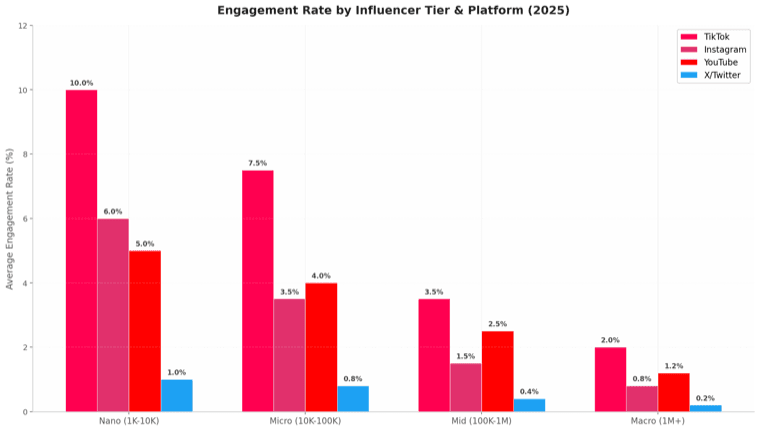 *Figure 3: The engagement rate drop-off as you scale followers. Notice how TikTok maintains the best rates across all tiers, while X struggles everywhere. Source: Industry benchmark data (qoruz.com) *
Nano KOLs (1K-10K followers) average 5-10% engagement. Micro KOLs (10K-100K) hit 2.5-7.5%. Macro KOLs (100K-1M+)? They limp along at 1-3.5% (qoruz.com).
It's not because macro influencers are bad at their jobs. It's math. When you have a million followers, a huge chunk of them are passive. They followed because of one viral moment, or because their friend shared something, or because the algorithm suggested it. They don't have a relationship with you. They're tourists, not locals.
Wondering which tier you fall into? Our Instagram Engagement Rate Calculator lets you punch in your numbers and see exactly where you sit on this chart. Fair warning: it can be an ego check.
Nano and micro influencers have communities. Their followers know them, trust them, engage with them. That trust translates directly into algorithmic performance because platforms now prioritize relationship signals over raw reach.
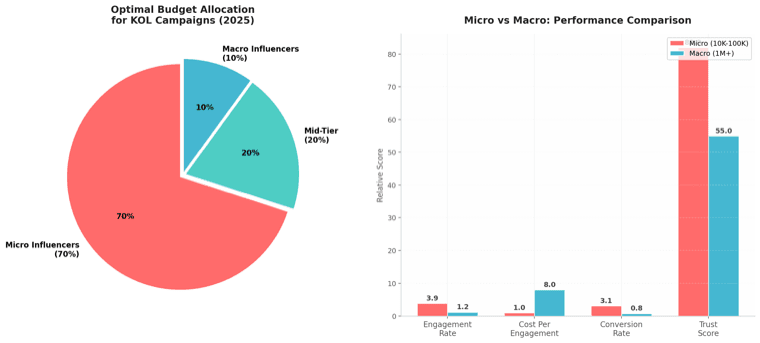 *Figure 4: The 70/20/10 budget split and why micro KOLs dominate on every metric that actually matters. Source: Influencer Fee, ATTN Agency (attnagency.com) (ContentMation) *
The smart budget allocation for brands? The 70/20/10 rule: 70% to micro KOLs, 20% to mid-tier, 10% to macro (attnagency.com). Micro KOLs deliver 3x the engagement rate and 8x lower cost per engagement. They also convert 22% higher (ContentMation). Macro KOLs are great for brand awareness, but if you want actual results, go small and specific.
Your Platform-Specific Playbook
Let's wrap this up with actionable tactics you can implement today.
On TikTok, front-load your hook. Optimize for shares, not likes. Use duets and stitches to spark user-generated content.
On Instagram, run a dual-track. Reels for reach, carousels for depth. Post during peak hours. Spend the first hour replying to comments. Use Stories with interactive stickers to build relationship signals.
On YouTube, think in series and playlists. End every video with a callout to related video. Reply to early comments within 2 hours. Keep your AVD above 40%.
On X, post opinions that spark debate. Reply to every reply with questions that extend the conversation. Prioritize text over video. A good thread beats a good video.
On all platforms, export and analyze your comments regularly. Whether you use CommentGrid or do it manually, your comment section contains more strategic intelligence than any dashboard. Your audience is telling you exactly what they want. The question is whether you're listening.
Final Thoughts: Stop Chasing the Algorithm. Start Chasing the Conversation.
Here's the paradox of social media in 2026: the more you obsess over algorithmic hacks, the worse you tend to perform. The creators who win are the ones creating content so genuinely engaging that the algorithm has no choice but to pay attention. Not the ones gaming the system.
Engagement rate isn't a metric you optimize. It's an outcome of creating content that resonates. Content that sparks reactions. Content that makes people feel something worth acting on. The algorithm doesn't reward manipulation. It rewards resonance.
Stop treating your comment section like a guestbook. Start treating it like your most valuable audience research tool. Stop chasing vanity metrics. Start building real relationships. And maybe grab a tool that makes the whole process less painful.
Want to see what your comments are really telling you? Give CommentGrid a spin. It's free, it's private, and it'll save you from copy-pasting usernames at 2 AM. Trust me, I've been there.
Now go make something worth talking about. The algorithm is watching.
Related Reading:
 M
MMarshall Sun
Building CommentGrid to decode social conversations. Exploring the signal within the noise of the global social web.